Rollator Walkers for Adults Over 60: How to Choose the Right One
Disclosure: This article contains affiliate links. If you make a purchase through one of these links, we may earn a commission at no additional cost to you. We only recommend products that are relevant to the subject of the article.
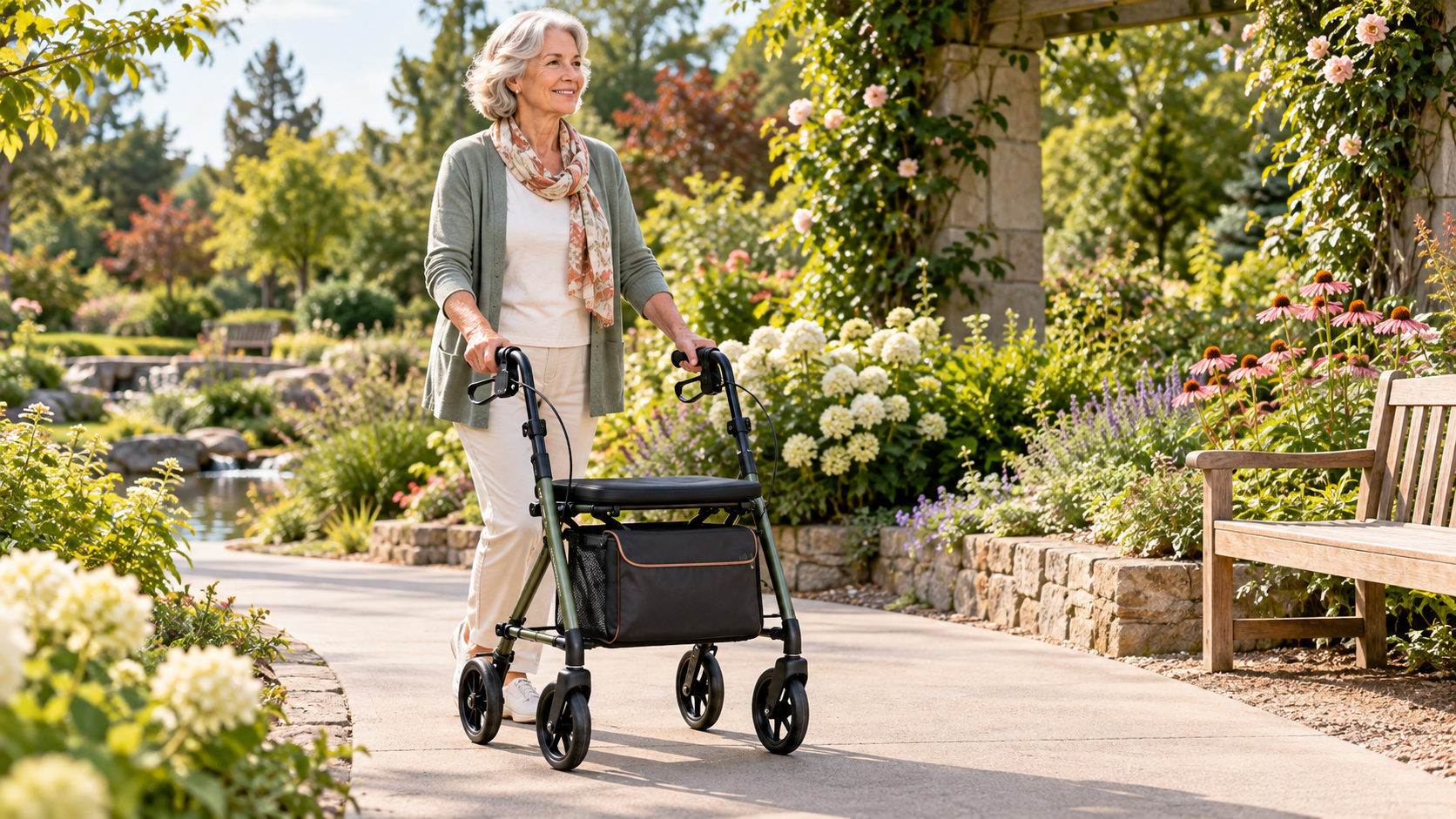
A rollator can provide helpful walking support while also offering conveniences that a traditional walker may not have, such as wheels, hand brakes, a seat and storage.
Choosing the right rollator, however, involves more than finding one with four wheels. The height must fit the user, the brakes must be comfortable to operate and the rollator must be narrow enough for the places where it will be used. Weight capacity, seat dimensions, wheel size and portability also matter.
This guide explains how to compare rollators and highlights three options for different needs: a lightweight model, a sturdy everyday model and an extra-wide heavy-duty model.
What Is a Rollator?
A rollator is a wheeled walking aid that is pushed in front of the user. Most have four wheels, handlebars with hand brakes, a built-in seat and a storage compartment.
Unlike a basic walker, a rollator is not normally lifted with every step. It rolls continuously as the user walks. That can make moving feel smoother, but it also means that the user must be able to control the wheels and operate the brakes safely.
A rollator is not appropriate for everyone. People who need to place substantial body weight through a walking aid may require a different type of walker. A healthcare professional or physical therapist can help determine which style of mobility aid is appropriate for an individual’s balance, strength and walking pattern.
Start With the Correct Height
A rollator that is too tall may make the shoulders rise uncomfortably. One that is too short can encourage the user to lean or hunch forward.
When comparing models, look at both the adjustable handle-height range and the manufacturer’s suggested user-height range. Do not assume that every rollator will fit every adult.
Some manufacturers offer the same rollator with multiple seat heights. This can be especially helpful because the correct seat height affects how easily a person can sit down and stand back up.
Consider the Width Carefully
Measure the narrowest doorway and hallway the rollator must pass through. Also consider bathroom entrances, bedroom doors, elevators and the space between furniture.
Product width becomes particularly important with heavy-duty rollators. A wider frame may offer more room and a larger seat, but it may not pass through every doorway.
Do not rely on visual estimates. Compare the manufacturer’s published overall width with actual measurements inside the home.
Check the Weight Capacity
The user’s weight should remain comfortably below the rollator’s stated maximum capacity. The weight of bags or items placed on the rollator may also need to be considered.
Never use a rollator above its published capacity. A higher capacity may also be useful for someone who prefers a wider frame or more substantial construction, even if they do not approach the maximum limit.
Decide How Portable It Needs to Be
If the rollator will frequently travel in a car, check its total weight and folded dimensions. A rollator described as “folding” may still be difficult for some people to lift.
Consider who will normally place it in the vehicle. A few pounds can make a meaningful difference when lifting a rollator over a trunk opening or into the back of an SUV.
Also check whether the rollator locks in its folded position. A folding lock can make it easier to lift and prevent the frame from opening unexpectedly during transportation.
Compare Wheel Size and Riding Surface
Larger wheels generally travel over sidewalk joints, thresholds and slightly uneven surfaces more easily than very small wheels. Eight-inch wheels are common on rollators intended for a combination of indoor and paved outdoor use.
No standard rollator should automatically be treated as an all-terrain device. Grass, gravel, steep slopes, broken pavement and wet surfaces can still create difficulties. Always follow the manufacturer’s guidance concerning appropriate surfaces.
Make Sure the Brakes Are Comfortable
Most rollators use bicycle-style hand brakes. The user squeezes the handles to slow down and pushes them into a locked position before sitting.
The brakes should be easy for the intended user to reach and operate. Someone with arthritis, reduced hand strength or limited use of one hand may need a specialized braking design.
Before sitting, both brakes should be fully locked and the rollator should be positioned on a firm, level surface. The seat is intended for stationary rest—not for riding while another person pushes the rollator unless the product is specifically designed and approved as a transport chair.
Three Rollators Worth Comparing
Best lightweight option: Nova Medical Zoom Series
The Nova Medical Zoom Series is a lightweight folding rollator with several available seat heights. That sizing flexibility makes it easier to select a model that fits the user instead of trying to make one standard height work for everyone.
Current specifications list a weight of approximately 15.6 pounds, a 300-pound capacity and eight-inch wheels. It also includes a padded seat, under-seat storage and hand brakes designed to require relatively little pressure.
The rollator’s folding system locks the frame in its folded position, which can make it more manageable when placing it in a vehicle or storing it at home.
Why we selected it:
- Approximately 15.6-pound product weight
- 300-pound weight capacity
- Available with 18-, 20-, 22- or 24-inch seat heights
- Eight-inch wheels
- Padded seat and storage pouch
- Locking folded position for transportation
Best suited for: Someone who wants a lighter rollator, expects to transport it regularly and appreciates having several seat-height options.
Best everyday option: Comodita Prima
The Comodita Prima provides a useful balance of capacity, comfort and portability. Its current specifications list a 400-pound capacity and an approximate product weight of 19.5 pounds.
The Prima has eight-inch rubber wheels, a padded seat, a padded backrest and locking hand brakes. It also includes an under-seat storage bag, cup holder and cane holder.
The handles adjust to accommodate users approximately 5 feet 4 inches to 6 feet 4 inches tall. Because that range will not fit everyone, shorter users should compare the smaller Comodita Piccola or another appropriately sized model.
Why we selected it:
- 400-pound weight capacity
- Approximately 19.5-pound product weight
- Eight-inch rubber wheels
- Padded seat and backrest
- Adjustable handle height
- Included storage bag, cup holder and cane holder
- Folding frame for storage and transportation
Best suited for: Someone seeking a sturdy everyday rollator with a comfortable seat, useful accessories and a higher-than-average weight capacity.
Best heavy-duty option: Comodita Spazio
The Comodita Spazio is designed for people who need more capacity and a wider sitting area. Its published specifications list a 440-pound capacity and a 19-inch-wide padded seat.
It also includes eight-inch wheels, adjustable handles, locking hand brakes, a padded backrest and under-seat storage. The frame folds for transportation and storage.
The additional width is important to understand before ordering. The Spazio is approximately 28 inches wide and the seller recommends a minimum doorway width of 30 inches. Measure every important doorway rather than assuming it will fit.
Why we selected it:
- 440-pound weight capacity
- 19-inch-wide padded seat
- Eight-inch wheels
- Adjustable 35- to 39-inch handle height
- Locking hand brakes
- Under-seat storage
- Folding frame
Best suited for: Someone who needs a wider seat, extra room and a higher weight capacity—and whose home has sufficiently wide doorways.
Quick Comparison
| Model | Best for | Capacity | Key advantage |
|---|---|---|---|
| Nova Zoom | Portability | 300 pounds | Multiple seat heights |
| Comodita Prima | Everyday use | 400 pounds | Comfort and accessories |
| Comodita Spazio | Extra width and capacity | 440 pounds | 19-inch-wide seat |
Questions to Ask Before Buying
- Is the handle-height range appropriate for the user?
- Is the seat at a comfortable height for sitting and standing?
- Does the seat provide adequate width and depth?
- Can the user comfortably squeeze and lock the brakes?
- Will the rollator fit through every necessary doorway?
- Can the user or caregiver lift it into the vehicle?
- Are its wheels appropriate for the intended surfaces?
- Does the product remain comfortably within its weight capacity?
- What parts are covered by the warranty?
- What is the seller’s return policy if the fit is unsuitable?
Important Rollator Safety Reminders
- Adjust the handles to the appropriate height before use.
- Lock both brakes before sitting down or standing up.
- Use the seat only on a firm, level surface.
- Do not allow someone to push a seated user unless the product is specifically approved as a transport chair.
- Do not hang heavy bags from the handles, as this could affect stability.
- Inspect the brakes, wheels and folding mechanisms periodically.
- Keep the rollator within its stated weight capacity.
- Ask a healthcare professional for help if you are uncertain about proper fit or use.
Which Rollator Should You Choose?
Choose the Nova Medical Zoom Series if low weight, easy transportation and multiple seat-height choices are your leading priorities.
Choose the Comodita Prima if you want a sturdy everyday rollator with a comfortable seat, included accessories and a 400-pound capacity.
Choose the Comodita Spazio if you need a wider seat and a 440-pound capacity—and have confirmed that its 28-inch frame will fit through your doorways.
The best rollator is not necessarily the lightest, widest or most expensive model. It is the one that properly fits the user, can be controlled comfortably and works in the places where it will actually be used.
Compare the Recommended Rollators
Lightweight and easy to transport:
Nova Medical Zoom Series
Sturdy choice for everyday use:
Comodita Prima
Extra width and higher capacity:
Comodita Spazio
Product specifications, availability and policies can change. Verify important measurements, capacities, warranty terms and return policies with the seller or manufacturer before purchasing. This article provides general consumer information and is not a substitute for individualized medical or mobility advice.