How to Choose the Right Lift Chair: A Practical Guide for Adults Over 60
A lift chair can look and feel much like an ordinary recliner, but its powered lifting mechanism can make sitting down and standing up considerably easier. For someone who struggles to rise from a chair, the right model may provide greater comfort and help them move around the home more independently.
Choosing one is not as simple as selecting a color and ordering a comfortable-looking chair. The chair must fit the person, the room and the way it will be used. Seat height, seat depth, positioning, controls and delivery arrangements can all affect whether the chair works well in everyday life.
Affiliate disclosure: This article contains affiliate links. If you make a purchase through one of these links, we may earn a commission at no additional cost to you. We only highlight products that appear genuinely relevant to the topic.
This article provides general consumer information and is not medical advice. Anyone with significant mobility limitations, balance concerns or a recent medical procedure should consult an appropriate healthcare professional about their individual needs.
What Is a Lift Chair?
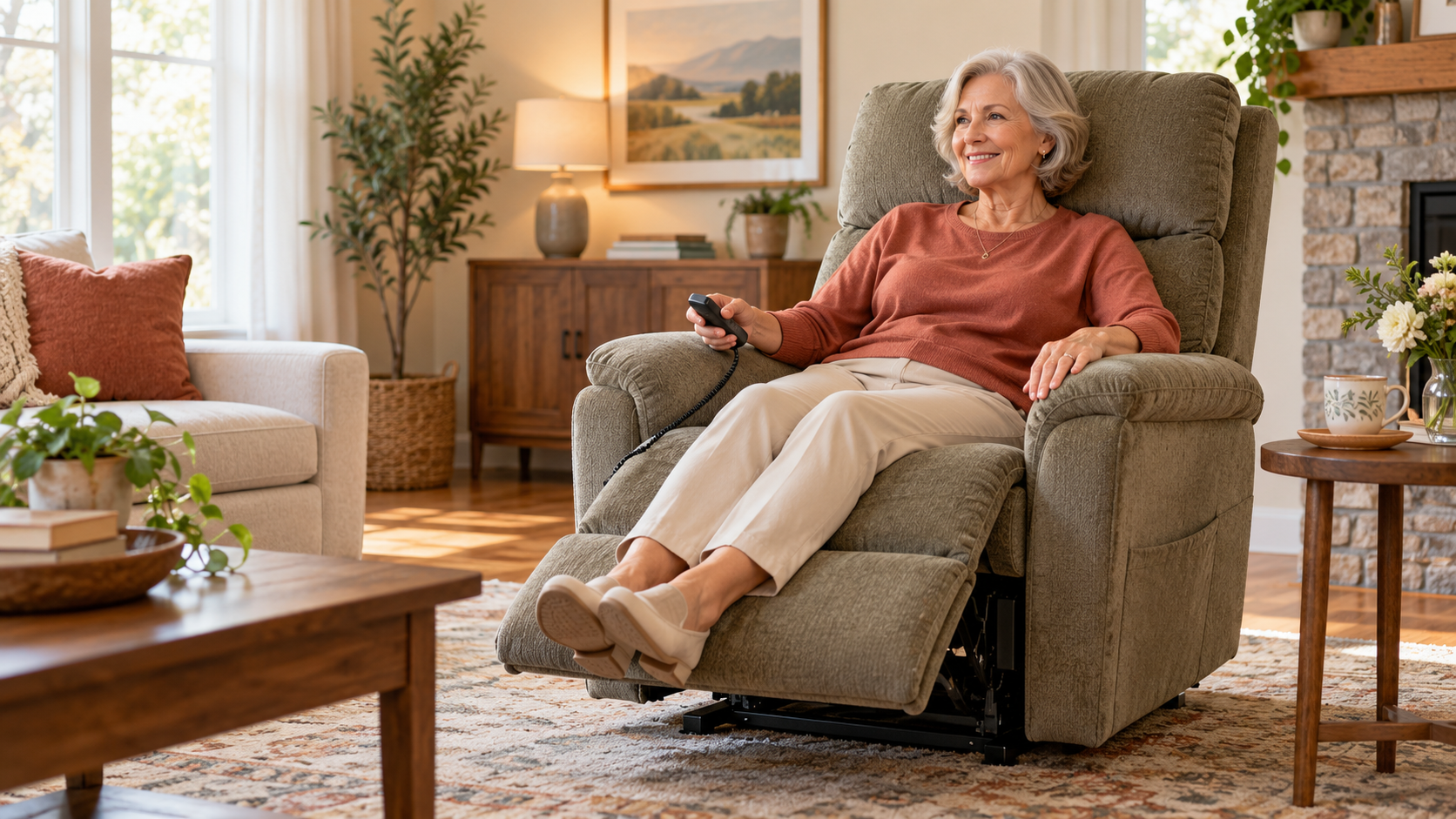
A lift chair is a powered recliner that moves between sitting, reclining and raised positions. When the user is ready to stand, the seat rises and tilts forward. This reduces the distance the person must lift themselves from a seated position.
The mechanism is intended to provide assistance—not to eject someone from the chair or support them while walking. The user still needs to place their feet securely on the floor and maintain enough balance to complete the transition safely.
Many current lift chairs also offer independently adjustable backrests and footrests, powered head and lumbar support, heating, massage, device charging and programmable positions. Those features can be valuable, but proper fit should come first.
Start With the Person Who Will Use It
Before comparing fabrics and features, consider how the chair will actually be used.
- Will it be the person’s primary chair every day?
- Will they regularly read, watch television, nap or sleep in it?
- Do they have difficulty operating small buttons?
- Would several preset positions be helpful or confusing?
- Do they need extra back, neck or leg support?
- Will anyone else regularly use the chair?
- Is there another mobility device that must remain within reach?
A chair used occasionally for television may not need the same positioning options as one used for extended periods throughout the day.
Proper Fit Is the Most Important Consideration
A lift chair should fit the user rather than simply fit the available space. Someone who is petite can feel lost in an oversized chair, while a taller person may receive inadequate leg, neck or back support from a chair that is too small.
Seat height
When the chair is in its normal seated position, the user’s feet should rest comfortably on the floor. If the seat is too high, the legs may dangle. If it is too low, standing may remain difficult even with the lifting mechanism.
Seat depth
The user should be able to sit against the backrest without the front edge of the seat pressing uncomfortably into the backs of the knees. A seat that is too deep may cause the person to slide forward, while one that is too shallow may not adequately support the thighs.
Seat width
There should be enough room to sit comfortably without being squeezed between the arms. However, substantially more width is not necessarily better. A chair that is too wide may provide inadequate lateral support and place the armrests too far away.
Back height and footrest length
The backrest should support the head and shoulders appropriately. When the footrest is extended, the legs should feel supported without placing excessive pressure behind the heels or knees.
Weight capacity
Always confirm the manufacturer’s stated capacity for the exact model and size being considered. Do not rely on the appearance of the chair or specifications from a similar model.
Practical tip: Record the user’s height and weight, along with measurements from a chair that currently fits well. A knowledgeable seller can use that information to help identify an appropriate size.
Understand the Different Positioning Options
The terminology used for lift chairs can be confusing. You may encounter descriptions such as two-position, three-position, infinite-position or zero-gravity-style positioning.
Basic reclining chairs
Basic models generally operate the backrest and footrest together. They may be perfectly adequate for someone who primarily wants assistance standing and a comfortable position for reading or watching television.
Infinite-position chairs
These chairs allow the backrest and footrest to move more independently. This provides greater control over the seating position and can be useful for people who spend substantial time in the chair.
Tilt and elevated-leg positions
Some premium models offer additional tilt positioning that changes the angle of the entire seating surface. These chairs may also make it possible to position the legs above the torso. Because needs vary, anyone considering a chair for a specific health-related reason should discuss positioning with an appropriate healthcare professional.
Features Worth Considering
Simple controls
The best remote is one the user can operate confidently. Look for clearly differentiated buttons, readable symbols and a cord or storage location that keeps the remote within easy reach.
A sophisticated remote with numerous settings is not automatically better. If the controls are frustrating, the user may avoid adjusting the chair altogether.
Programmable positions
Memory buttons let users save positions they use frequently. This can be convenient when a chair offers independently powered back, foot, head and lumbar adjustments.
Power headrest and lumbar support
These features allow the user to adjust support without repositioning pillows. They may be especially useful for reading or watching television while reclined.
Footrest extension
A footrest extension may provide better support for taller users. Confirm that the person’s legs and heels are comfortably supported when the chair is fully reclined.
Heat and massage
Built-in heat and massage can make a chair feel more comfortable, but they should be treated as optional comfort features rather than the main reason to select a poorly fitting chair.
Users should follow the manufacturer’s instructions and speak with a healthcare professional if they have conditions that affect heat sensitivity, circulation or sensation.
Charging and storage
USB ports, wireless charging areas and hidden cup holders are convenient for someone who spends significant time in the chair. Make sure cords, tables and charging devices do not create a tripping hazard around the chair.
Battery backup
Because the chair depends on electricity, ask exactly what its backup system can do during an outage. Backup capabilities vary. Follow the manufacturer’s replacement and maintenance instructions rather than assuming a battery will remain ready indefinitely.
Measure the Room Before Ordering
A lift chair needs room to recline and room to rise. Measure more than the chair’s upright footprint.
- Measure the available width, depth and height.
- Check the manufacturer’s required clearance from the wall.
- Confirm that the chair will not block a doorway or walking path.
- Locate a suitable electrical outlet.
- Avoid placing the power cord across an open walkway.
- Consider whether an end table will interfere with the lifting motion.
- Make sure the user can safely approach and leave the chair with any walker or cane they use.
Also measure the doors, hallways and turns between the home’s entrance and the intended room. A chair that fits perfectly in the living room is of little use if it cannot be delivered through the doorway.
Three Lift Chairs to Consider
The following models illustrate how different sizes and feature combinations may suit different users. Product features and availability can change, so confirm the current specifications, delivery choices and return terms before ordering.
Pride VivaLift! Ultra PLR4955M
Potentially best for: Someone seeking a feature-rich medium-size chair with extensive positioning and comfort controls.
The VivaLift Ultra offers independently adjustable positioning, powered head and lumbar support, a footrest extension, heating zones, lower-back massage, a programmable position and tilt functionality. It also includes charging and storage conveniences.
This is the strongest option of the three for someone who expects to spend substantial time in the chair and will genuinely use its additional adjustments. Those features also make it important to confirm that the user is comfortable operating the controls.
Pride VivaLift! Radiance PLR3955PW
Potentially best for: A shorter user who needs a wider seat and wants premium heat and positioning features.
This petite-wide model combines true-infinite positioning with powered head, lumbar and backrest adjustments. It also offers heating in the shoulder, lumbar and seat areas, programmable memory positions, a footrest extension and charging conveniences.
The petite-wide configuration is the distinguishing consideration. It may be appropriate for someone who needs a lower or shorter chair while still benefiting from additional seat width. Actual measurements—not the “petite wide” label alone—should determine whether it fits.
Pride Evolution LC-435L
Potentially best for: A larger or taller user who needs a roomier chair and prefers more straightforward operation.
The large Evolution model emphasizes generous seating and powered lift-and-recline functionality. It is worth considering when the user needs more room than a medium chair provides but does not necessarily require every premium electronic feature.
Confirm the exact seat width, depth, recommended user-height range and weight capacity shown on the product page before ordering. Those measurements are more meaningful than choosing “large” based only on the model name.
Delivery and Setup Matter
Lift chairs are large and heavy. Before placing an order, determine exactly what the quoted delivery service includes.
- Will the chair be left at the curb or brought inside?
- Does delivery include placement in the intended room?
- Will packaging materials be removed?
- Is assembly included?
- Will the delivery team demonstrate the controls?
- What happens if the chair cannot fit through the doorway?
- What does optional white-glove service cost?
New Leaf states that freight shipping is available to the contiguous United States and that white-glove delivery and in-home setup may be available. Confirm the current arrangements for the specific chair and delivery address before ordering.
Check the Return and Warranty Terms
Furniture and mobility products can have more restrictive return conditions than ordinary household merchandise. Read the seller’s current policy before purchasing, especially if the chair is specially configured, assembled or placed into service.
Also verify:
- Which parts are covered by the manufacturer’s warranty
- How long the frame, electrical components and upholstery are covered
- Who provides service in your area
- Whether an in-home repair visit carries a service charge
- Who pays return freight if the chair is eligible for return
A Lift-Chair Checklist
Before making the final decision, confirm all of the following:
- The seat height, depth and width fit the user.
- The backrest and footrest provide appropriate support.
- The stated weight capacity is suitable.
- The user can understand and operate the controls.
- The positioning options match how the chair will be used.
- The chair has enough room to rise and recline safely.
- The electrical cord will not cross a walking path.
- The chair can fit through every doorway on the delivery route.
- The delivery service includes everything you expect.
- You have reviewed the current return and warranty terms.
The Bottom Line
The best lift chair is not necessarily the largest, softest or most expensive option. It is the chair that properly fits the user, provides useful—not merely impressive—features, works within the room and can be operated confidently every day.
Start with body measurements and intended use. Then compare positioning, controls, room clearance, delivery and service. Taking those steps before ordering can make the difference between a chair that merely reclines and one that becomes a genuinely useful part of everyday life.