15 Simple Ways to Make Your Home Safer After 60—Without Major Remodeling
Your home should be a place where you feel comfortable, confident and free to enjoy your normal routines. Fortunately, making it easier and safer to navigate does not necessarily require an expensive renovation.
Many useful improvements are surprisingly simple: better lighting, clearer walkways, more convenient storage and a few carefully selected household products. You can complete some in minutes and tackle others gradually, one room at a time.
The goal is not to make your home look clinical or change everything because you have reached a certain age. It is to remove everyday frustrations and prevent avoidable hazards while preserving the warmth and personality of your home.
Disclosure: This article contains affiliate links. If you make a qualifying purchase through one of these links, we may earn a commission at no additional cost to you. As an Amazon Associate, we earn from qualifying purchases.
1. Improve the Lighting Near Entrances
Begin with the areas where you enter and leave your home. A dark porch, poorly lit walkway or shadowy garage entrance can make it difficult to see steps, uneven pavement, packages or objects left near the door.
Replace burned-out bulbs promptly and consider brighter fixtures where existing lighting is inadequate. Position lights so they illuminate the walkway and door without shining directly into your eyes.
If you arrive home after dark, automatic dusk-to-dawn or motion-activated exterior lighting can eliminate the need to find a switch while carrying groceries or luggage.
2. Add Motion-Sensor Night-Lights
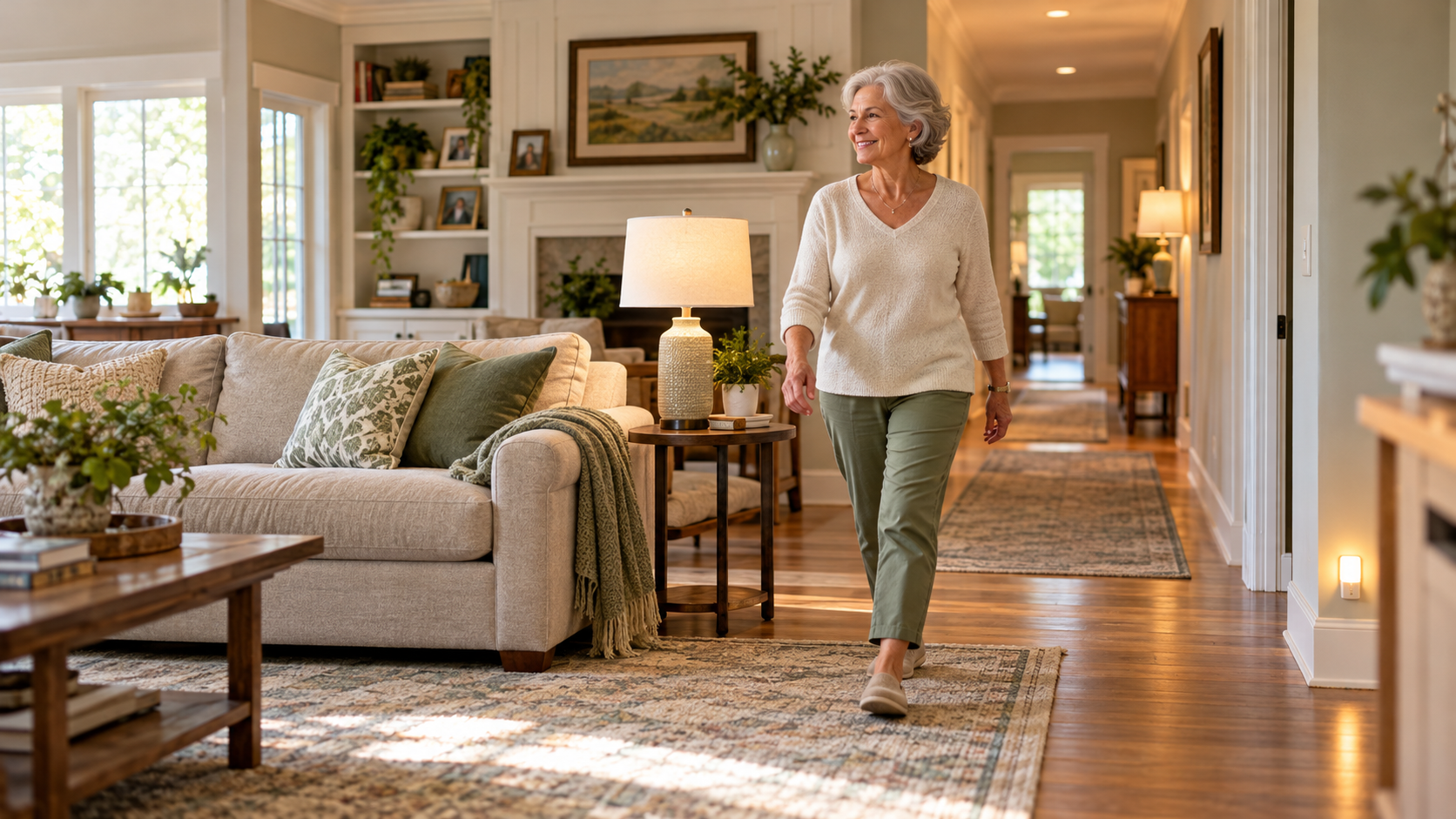
Trips to the bathroom or kitchen are easier when the route is gently illuminated. Small motion-sensor night-lights can provide enough visibility to identify walls, furniture and changes in flooring without requiring you to turn on a bright overhead light.
Good locations include bedrooms, hallways, bathrooms and the route between frequently used rooms. Choose lights that provide a soft, warm glow and position them low enough to illuminate the floor.
See Motion-Sensor Night-Light Options
3. Secure Loose Rugs and Mats
A rug that slides, curls at the corners or bunches underfoot can become a nuisance in an otherwise clear room. Walk through the house and inspect every area rug, runner, bath mat and doormat.
Remove rugs that do not serve a useful purpose. Rugs you want to keep should lie flat and have an appropriate nonslip backing or rug-gripping material underneath them.
Do not assume a rug is secure simply because it has not moved before. Test it by applying light pressure from several directions, and check it periodically as backing materials can wear down.
See Nonslip Rug-Gripper Options
4. Move Electrical Cords Out of Walkways
Phone chargers, extension cords and lamp cords often migrate into walking paths because outlets are not always conveniently located. Avoid stretching a cord across a doorway, hallway or open section of flooring.
Move the device closer to an outlet when possible. Cords that must cross an exposed area should be protected with a low-profile cord cover designed for the flooring involved.
Avoid hiding electrical cords under rugs, where they can create an uneven surface and may be damaged without being noticed.
See Low-Profile Floor Cord Covers
5. Make Bathroom Floors Less Slippery
Water, smooth tile and limited space can make a bathroom difficult to navigate. Use a secure, water-resistant nonslip surface in the tub or shower and an absorbent mat with a nonslip backing outside it.
Keep towels within easy reach so you do not need to cross the room while wet. Wipe up water promptly and check periodically for plumbing leaks or condensation that may leave the floor damp.
A bath mat should lie flat and remain in place when stepped on. Replace it if the backing cracks, curls or loses its grip.
6. Install Grab Bars Where Support Is Needed
A properly installed grab bar can provide reliable support near a bathtub, shower or toilet. However, installation matters just as much as the bar itself.
Towel racks and soap dishes are not designed to support a person’s weight. Grab bars should be securely fastened to suitable structural support or installed with mounting hardware appropriate for the wall construction.
Because the best placement depends on the room and the person using it, consider having a qualified professional evaluate and install the bars.
7. Keep Frequently Used Items Within Easy Reach
Repeatedly bending to a low cabinet or reaching above shoulder height can make routine tasks unnecessarily difficult. Move frequently used dishes, cookware, toiletries and cleaning supplies to shelves between approximately waist and shoulder height.
Reserve the highest and lowest storage areas for lightweight items you rarely need. Heavy objects should be stored where you can lift them without stretching, twisting or standing on something.
This simple reorganization can improve convenience without purchasing anything.
8. Check Stairways and Handrails
Every stairway should have consistent lighting and a clear path from top to bottom. Do not use stairs as temporary storage for shoes, packages, laundry or household items.
Check that handrails feel secure and extend far enough to be useful when entering or leaving the staircase. Ideally, a person should be able to reach the rail before taking the first step.
If a handrail moves when pulled, have it repaired rather than simply tightening an accessible screw and assuming the underlying attachment is secure.
9. Make Stair Edges Easier to See
Steps can be difficult to distinguish when the flooring and stair edges are similar in color. Good lighting is the first priority, but carefully placed contrasting material may also improve visibility.
Any tape or marking used on stairs must be firmly attached and suitable for the surface. Avoid thick materials or decorations that could create a raised edge.
If you are uncertain about the best solution, ask a qualified home-safety or remodeling professional to evaluate the staircase.
10. Replace Unstable Step Stools
Dining chairs, folding chairs and boxes should never substitute for a step stool. If you occasionally need additional height, use a sturdy household step stool designed for that purpose.
Look for wide steps, secure nonslip feet and a supportive handle or rail. Place the stool on a level surface and follow the manufacturer’s instructions, including its height and weight limitations.
The better long-term solution is still to relocate frequently used items so climbing is rarely necessary.
See Stable Step Stools With Support Handles
11. Create a Bedside Essentials Station
Keep nighttime necessities within comfortable reach of the bed. Depending on your routine, this might include eyeglasses, a phone, water, tissues, medication taken at night and a lamp.
A bedside table or organizer should reduce clutter rather than create it. Keep charging cords away from the walking path, and avoid leaving objects on the floor beside the bed.
Make sure you can turn on a light before standing. If the lamp switch is difficult to reach, consider repositioning the lamp or using a convenient touch-control model.
12. Keep an Emergency Flashlight Accessible
A power outage can instantly turn familiar rooms into unfamiliar spaces. Keep a dependable flashlight in an easy-to-reach location rather than buried in a drawer filled with miscellaneous items.
Useful locations include the bedside table, kitchen and main living area. Rechargeable models should be checked periodically, while battery-powered flashlights need fresh batteries available nearby.
A phone flashlight can help, but a dedicated flashlight is easier to locate and does not consume the phone battery you may need for communication.
See Rechargeable Emergency Flashlights
13. Make Your House Number Clearly Visible
Emergency responders, delivery drivers and visitors should be able to identify your home quickly from the street. Check your house number during both daylight and darkness.
Numbers should be large enough to read, clearly contrast with their background and remain unobstructed by plants, decorations or parked vehicles. If the entrance is set back from the road, a second number near the driveway may be helpful where local rules permit it.
Consider adding lighting if the existing number disappears into the shadows at night.
14. Test Smoke and Carbon-Monoxide Alarms
Test alarms according to the manufacturer’s directions and replace batteries and units when recommended. Do not wait for the low-battery chirp to make this part of your household routine.
Confirm that alarms can be heard from bedrooms when doors are closed. People with hearing loss may benefit from specialized alerting devices, but the appropriate setup depends on the home and the individual.
Follow current guidance from your local fire department concerning alarm types and placement.
15. Prepare a Household Emergency-Information Sheet
Create a simple printed sheet containing important phone numbers, emergency contacts, your home address and other information someone in your household might need quickly.
Place it in a known location, such as inside a kitchen cabinet, and give a copy to a trusted family member when appropriate. Review it periodically so outdated telephone numbers and instructions do not remain in circulation.
A printed sheet remains available during a power outage or when a phone cannot be unlocked.
Begin With One Room
You do not need to complete every improvement in one weekend. Begin with the room you use most often or the area that currently causes the most frustration.
Walk through that space during the day and again after dark. Look for poor lighting, unstable rugs, obstructed pathways, inconvenient storage and items that require unnecessary reaching or climbing.
Fix the easiest issue first, then choose one improvement for the following week. A series of small, sensible changes can make your home more comfortable and easier to navigate while allowing it to continue looking and feeling like your home.
This article provides general household information and is not a substitute for individualized medical, occupational-therapy, construction or home-safety advice. Consult an appropriate qualified professional when an improvement requires specialized evaluation or installation.