Mobility Scooters for Adults Over 60: A Practical Buying Guide
Disclosure: This article contains affiliate links. If you make a purchase through one of these links, we may earn a commission at no additional cost to you. We only include products that are relevant to the subject of the article.
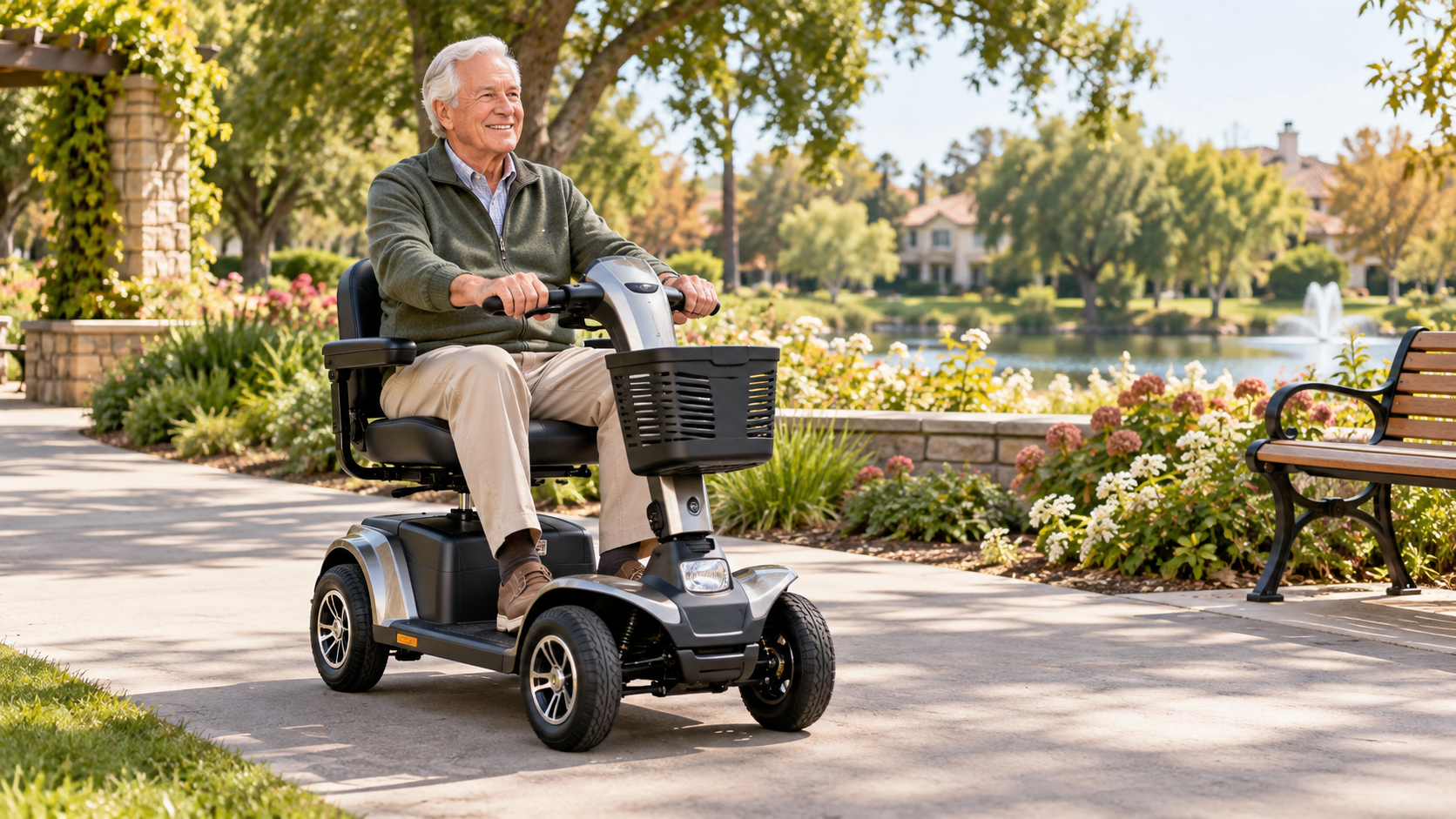
A mobility scooter can make shopping, traveling, visiting family and enjoying the outdoors considerably easier. The challenge is choosing one that fits both your physical needs and the way you expect to use it.
The most expensive or powerful scooter is not automatically the best choice. A lightweight folding scooter may be ideal for someone who travels frequently, while a larger scooter may provide better comfort and stability for neighborhood trips. The right choice depends on factors such as portability, riding surface, range, seating comfort and weight capacity.
This guide explains the major differences among travel, mid-size and full-size mobility scooters so you can narrow your options before making a purchase.
Begin With How You Will Use the Scooter
Before comparing models, think about where the scooter will be used most often.
- Will you primarily use it inside stores, restaurants or senior communities?
- Will you ride outdoors on sidewalks and paved neighborhood streets?
- Will you need to load it into a car?
- Will you take it on cruises or airplanes?
- Will someone regularly be available to help lift or assemble it?
- How long do you expect to remain seated during a typical outing?
Your answers will usually point toward one of three categories: a folding travel scooter, an all-around mid-size scooter or a full-size scooter designed for longer outdoor trips.
1. Travel and Folding Mobility Scooters
Travel scooters are designed for portability. Some fold as one unit, while others separate into several smaller sections that can be placed in a vehicle.
These scooters are generally easier to maneuver in stores, cruise terminals and other crowded spaces. Their smaller size also makes them more practical for people who do not have room to store a full-size scooter.
The tradeoff is that compact scooters may have smaller seats, less ground clearance, shorter driving ranges and limited suspension. They are usually most comfortable on smooth, level surfaces.
Recommended travel option: EV Rider Transport 4AF
The EV Rider Transport 4AF is a four-wheel folding scooter designed for people who place a high priority on transportation and storage. It folds automatically using a key fob, eliminating the need to disassemble the scooter into several separate sections.
According to the current product specifications, it has a 250-pound load capacity, a range of up to 10 miles and a net weight of approximately 52 pounds. Its four-wheel design provides additional stability compared with many three-wheel travel scooters.
This model may be a good fit if you:
- Frequently travel by car, cruise ship or airplane
- Want a scooter that folds without extensive disassembly
- Primarily ride on smooth indoor floors and paved surfaces
- Can safely manage its folded weight or have assistance available
Always confirm current airline and cruise-line battery requirements directly with the carrier before traveling. Approval of a particular battery type does not guarantee that every carrier will handle the scooter in the same manner.
View the EV Rider Transport 4AF
2. Mid-Size Mobility Scooters
A mid-size scooter offers a balance between maneuverability and comfort. These models are generally larger and more supportive than travel scooters but easier to handle than the heaviest full-size models.
Many mid-size scooters include a more substantial seat, greater weight capacity, larger tires and a longer driving range. Some can be partially disassembled for transportation, although their individual sections may still be too heavy for one person to lift safely.
This category often works well for everyday errands, shopping centers, retirement communities and paved outdoor areas.
Recommended all-around option: Pride Victory 10 3-Wheel
The Pride Victory 10 3-Wheel combines a relatively tight turning radius with the seating and performance expected from a more substantial scooter.
Its current specifications list a 400-pound weight capacity, a maximum range of up to 16 miles and a 42-inch turning radius. It also includes a high-back adjustable seat, flip-back armrests, a headlight and a delta tiller that can be operated with either hand.
The three-wheel design makes turning in tighter areas easier than it would be with many comparable four-wheel scooters. However, riders who prioritize maximum stability—especially on uneven outdoor surfaces—may prefer a four-wheel model.
This model may be a good fit if you:
- Want one scooter for both indoor and outdoor errands
- Need more seating comfort than a compact travel scooter provides
- Benefit from a tighter turning radius
- Need a higher weight capacity
- Do not expect to lift the entire scooter into a vehicle unaided
View the Pride Victory 10 3-Wheel
3. Full-Size and Heavy-Duty Mobility Scooters
Full-size scooters are built for riders who value comfort, outdoor performance and range more than portability. They commonly include larger captain’s seats, suspension systems, larger batteries and more substantial frames.
These scooters can be excellent for neighborhood trips, large outdoor attractions and extended outings. However, they require more storage space and may need a vehicle lift, ramp or appropriately sized vehicle for transportation.
Do not assume that a scooter can be lifted into a car simply because it can be disassembled. Check the weight of the heaviest individual section—not just the scooter’s total weight—and realistically assess who will be responsible for lifting it.
Recommended full-size option: Pride Victory LX Sport
The Pride Victory LX Sport is designed for riders seeking a more supportive seat, full suspension and stronger outdoor performance.
Its current specifications include a 400-pound weight capacity, front and rear suspension and a maximum range of up to 19.7 miles under specified test conditions. The scooter also includes a high-back captain’s seat, solid tires, lighting, directional signals and an ergonomic delta tiller.
The published range varies according to rider weight, terrain, battery condition, temperature and driving habits. Treat any advertised maximum as a comparison figure rather than a guaranteed distance for every outing.
This model may be a good fit if you:
- Expect to spend longer periods seated on the scooter
- Will regularly travel on sidewalks or other varied paved surfaces
- Want front and rear suspension
- Need a 400-pound weight capacity
- Have adequate storage and a realistic transportation plan
View the Pride Victory LX Sport
Three Wheels or Four?
A three-wheel scooter typically has a tighter turning radius and more room for the rider’s feet. This can make it easier to navigate indoor spaces, narrow aisles and smaller elevators.
A four-wheel scooter generally provides a broader base of support. Many riders prefer this configuration for outdoor use and uneven surfaces.
Neither configuration is automatically right for everyone. Your balance, turning environment, riding surface and comfort level should all influence the decision. If possible, test both designs before buying.
Check the Scooter’s Real Transport Weight
Product descriptions sometimes emphasize words such as “portable” or “transportable,” but those terms do not necessarily mean that one person can lift the scooter safely.
Before purchasing, check:
- The scooter’s total weight
- The weight without its batteries
- The weight of the heaviest section after disassembly
- Whether the battery must be removed before lifting
- The dimensions when folded or disassembled
- The size and height of the vehicle’s cargo opening
If lifting will be difficult, consider a vehicle lift or ramp rather than risking an injury to yourself or a family member.
Do Not Rely Solely on the Advertised Range
A scooter’s published range is normally based on specific testing conditions. Actual range can be affected by:
- Rider weight
- Hills and inclines
- Grass, gravel or rough pavement
- Frequent stopping and starting
- Cold or extremely hot weather
- Battery age and charging habits
- Accessories and additional cargo
Choose a scooter with more advertised range than you expect to need. Avoid planning outings that depend on using every last mile of the battery’s stated capacity.
Measure Before You Buy
Measure every area through which the scooter will need to travel or be stored. Important measurements include:
- Exterior and interior doorways
- Hallways and tight corners
- Elevators
- Garage or storage space
- Vehicle cargo openings
- Ramps and vehicle lifts
Also compare the scooter’s turning radius with the space available inside your home. Overall width alone does not tell you whether the scooter can turn comfortably in a hallway or room.
Comfort Matters More Than It Appears Online
A seat that seems adequate for a short test may become uncomfortable during a long shopping trip. Compare the seat’s width, depth, back height, padding and adjustability.
Look for armrests that support you without making entry difficult. A swivel seat can make getting on and off easier, while a delta-style tiller may be more comfortable for people with limited hand strength or dexterity.
Foot and leg position also matter. Confirm that the scooter provides sufficient legroom without requiring an awkward knee or hip position.
Consider Service, Warranty and Replacement Parts
A mobility scooter is a substantial purchase containing batteries, electronics, tires and mechanical components that may eventually require service.
Before purchasing, review:
- The manufacturer’s warranty
- What labor and transportation expenses are excluded
- Who handles warranty requests
- Whether replacement batteries and parts are readily available
- Whether local service is available in your area
- The seller’s cancellation, damage and return policies
Keep the owner’s manual, serial number, purchase documentation and warranty information together after delivery.
Questions to Ask Before Ordering
- Is the scooter appropriate for my height and weight?
- What does the heaviest removable section weigh?
- Will it fit through my doors and inside my vehicle?
- Is it designed for the surfaces where I intend to ride?
- What range should I realistically expect?
- How and where can the scooter be serviced?
- What happens if the scooter arrives damaged?
- What parts of the warranty require the owner to pay labor or shipping?
- Does my airline, cruise line or transportation provider impose additional requirements?
Which Type of Mobility Scooter Is Right for You?
Choose a folding travel scooter when easy transportation, compact storage and use on smooth surfaces are your leading priorities.
Choose a mid-size scooter when you want a practical balance of maneuverability, seating comfort, range and everyday performance.
Choose a full-size scooter when comfort, suspension, outdoor capability and longer trips matter more than easy lifting or compact storage.
The best mobility scooter is not simply the model with the longest range or highest speed. It is the model that fits your body, surroundings, transportation arrangements and normal routine.
Compare the Three Recommended Options
For folding and travel:
EV Rider Transport 4AF
For everyday all-around use:
Pride Victory 10 3-Wheel
For full-size comfort and outdoor performance:
Pride Victory LX Sport
Product specifications, availability and policies can change. Confirm important measurements, capacities, travel requirements and warranty terms with the seller or manufacturer before purchasing. If you are uncertain whether a mobility scooter is appropriate for your individual physical needs, consult a qualified healthcare or mobility professional.